
BIOGRAPHY
(Mendoza, 1913- Buenos Aires, 2003)
By Laura Ortega
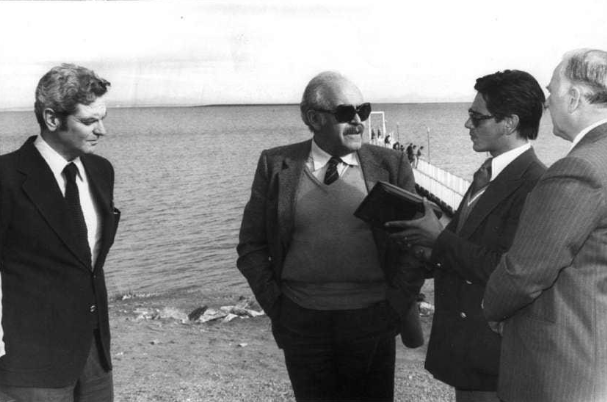
Guillermo Jorge Cano (1913-2003)
He was born in Mendoza, the son of Guillermo Cano, a conservative Democratic Party leader and provincial governor. He earned his law degree from the National University of Cuyo and originally specialized in water law.
In 1952, he began his association with various United Nations agencies after a trip to Rome. He served in the Economic Commission for Latin America (ECLAC), where he addressed water and natural resources issues. He also participated in important international conventions, such as the United Nations Interregional Seminar on the Integrated Utilization of Water Resources (1966) in Fergana (USSR). Following this participation, he was appointed director of the United Nations World Water Resources Programme. This position earned him great international recognition in this field.
This expertise led him to produce numerous and diverse publications related to water, energy, natural resource management and policy, and later, environmental issues, both within his specialty and, as he defined it, across disciplines (Haidar et al., 2015).
Some research indicates that his professional work analyzing problems related to water and its interconnection with other natural resources led him to innovate in the legal field in the comprehensive treatment of natural resources, by proposing a theory on the subject. This theory was presented in 1959 in the draft Natural Resources Code for Jujuy (Argentina). The circulation of his proposals was facilitated by his work in the Natural Resources and Transport Division of the Economic and Social Department of the UN Secretariat (1968-1971), and was recommended by the UN Committee on Natural Resources (Cano, 1975) (Haidar et al., 2015).
Another role in which he excelled was in teaching, both as a visiting and permanent professor, at various national universities such as those of Cuyo, La Plata, El Salvador, the Catholic University of Argentina (UCA), and Buenos Aires, as well as at foreign universities such as the University of Derlft (Netherlands).
In the technical-political field, he succeeded in establishing a national secretariat dedicated to Water Resources in Argentina, being elected its first secretary in 1969. Due to his many connections and relationships, he was appointed to participate in the first United Nations Conference on the Human Environment, held in Stockholm in 1972, as well as in other international summits. Among other notable events was the Third World Congress on Water Resources, held in Mexico in 1979. On that occasion, he was elected president of the International Water Resources Association (1979-1981).
He was also active in associations, and in the early 1950s, together with other specialists, he created the International Water Law Association, although it was not the only one. In 1978, in Argentina, he created the Journal of Law, Policy, and Administration in Environment and Natural Resources, a space for the dissemination of knowledge and research. This publication also served as the platform for the creation of the Environment and Natural Resources Foundation (FARN) in 1987, which he led until 1992.
In 1984, he joined the National Academy of Moral and Political Sciences and created the Environmental Policy Institute within it, with the aim of concentrating analysis and research on environmental issues.
Sources:
Cano, G. (1975). Marco Jurídico-Institucional para el manejo de los Recursos Naturales, Organización de las Naciones Unidad para la Agricultura y la Alimentación, Roma. Disponible en http://www.fao.org/4/h0422s/h0422s.pdf
Haidar, V. Berros, M. y Levrand, N. (2015). “Hacia una historia de la cuestión ambiental en América Latina: un análisis de los aportes de Guillermo Cano”, en Revista de historia del derecho, (50) Recuperado en 11 de octubre de 2024, de https://www.scielo.org.ar/scielo.php?script=sci_arttext&pid=S1853-17842015000200002&lng=es&tlng=es
Rojas, F. Suriani, J. y F. Martín (2018). “Historias ambientales de domadores y guardianes de aguas”, en Diario Los Andes. Disponible en Historias ambientales de domadores y guardianes de aguas (losandes.com.ar)
https://www.lanacion.com.ar/cultura/guillermo-jorge-cano-nid542935